
CybertronIT Blog
Cybertron Blog
Cybertron has been serving the Wichita area since 1997, providing IT Support such as technical helpdesk support, computer support, and consulting to small and medium-sized businesses.

Passwords are still the front door to most of your business data, and a weak one undoes a lot of other protection. The trouble is that people make passwords convenient for themselves, which usually means convenient for attackers too. Here is what actually makes a password strong, and how to build ones you can live with.
0 Comments

Cyberthreats are not occasional events anymore. They are constant, automated, and often sophisticated, which means a business that only reacts to attacks lives in permanent damage control. Waiting until something breaks to think about security is the most expensive plan there is. Getting ahead of it is the only approach that actually holds. Here is what waiting really costs, and what getting ahead looks like.

The scariest breaches are the quiet ones. An attacker phishes one employee's username and password, logs in, and walks straight into your network with no alarms going off, because as far as the system can tell, it is that employee. The single highest-impact fix for this is multi-factor authentication. Turning it on does more to lower your risk, for less money and effort, than almost anything else you can do. Here is how to roll it out, from good to best.

Most businesses have one. That crusty, critical application the whole operation depends on, sitting on an old platform the vendor abandoned years ago. You cannot patch it, and you cannot rip it out overnight, so it sits there as a blinking security hole in the middle of your network. The good news is you do not have to replace it tomorrow to make it safe. You contain it. Here is how.

You have heard "if it ain't broke, don't fix it," and for a lot of things that is fine advice. For IT, it can be the expensive kind of wrong. Technology that still turns on every morning can quietly be one of the biggest risks in your business, because "still working" and "still safe to rely on" are not the same thing. Here is why holding onto old systems too long catches up with you.

Have you stopped to wonder whether the voice on the phone is a person or an AI? You will be asking that a lot more often. Agentic AI takes the weakest part of your security, the human trust that a familiar voice, face, or login is genuine, and lets attackers fake it convincingly and at scale. The old gut check of "that sounds like my boss" no longer holds.

You can have every security tool on the market and still get breached through one tired click. People are where most attacks land, which makes training your team one of the highest-return security moves you can make. The catch is that the way most businesses do it, a once-a-year video everyone clicks through on mute, changes almost nothing. Here is how to build training that actually shifts behavior.

For years the patching rhythm was simple. A vendor released fixes, you applied them on a monthly cycle, and that was good enough. It is not anymore. Attackers now use AI to take a brand-new patch apart and build a working exploit in hours instead of weeks, which means the gap between a fix being released and your systems actually having it is the window they walk through. A once-a-month patch routine is starting to look less like diligence and more like an open door.
Cyber insurance feels like a safety net right up until a claim gets denied, and denials happen more than most owners expect. Put yourself in the insurer's seat. They are not eager to pay out for damage that simple, well-known precautions would have prevented. So they have started requiring a baseline of security controls, and if you do not have them, or you said you did and you did not, your payout can vanish at the exact moment you need it. Here are the three that come up most.

The biggest weakness in most networks is not the firewall. It is the people, and attackers know it. They count on your team being busy, stressed, and trying to be helpful, so they manufacture moments where someone clicks first and thinks later. The fix is almost embarrassingly simple. Give people permission to slow down. Call it the three-second rule, a short pause before acting on any message that wants something from you. Here is why that tiny habit punches so far above its weight.

If your technology only gets attention when something breaks, it is a cost center, and cost centers do not help you grow. The businesses that scale cleanly treat IT as strategy, not as a line item to dread. The catch is that most small and mid-sized businesses cannot justify a full-time technology executive. That is exactly the gap a virtual CIO fills.

Your point-of-sale system is not just where you take payment. It is where sales, inventory, customer data, and daily operations all meet, which means when it gets neglected it quietly turns into the thing slowing your business down. These are the five POS and IT problems we see hitting businesses in 2026.

AI is woven into business in 2026, and the next wave is not just generating content. It is agentic AI, tools that take action on your behalf. Businesses have been eager for assistants that can actually do things. One open-source project showed both the promise and the danger of that, and it did so in spectacular fashion.
How one tool went off the rails
In the span of a few weeks, a single AI tool changed its name three times, was hijacked into a multi-million-dollar crypto scam, left thousands of users exposed to hackers, and spawned what people called the first AI religion. It started innocently. A developer named Peter Steinberger built an open-source agent first called Clawd, built on Anthropic Claude model. Fans dubbed it Claude with hands, an agent that could control your computer, manage email, organize files, and run commands. It went viral overnight.
The ten-second heist
Anthropic legal team pointed out that the original name was a little too close to Claude, so Steinberger rebranded, eventually landing on Moltbot, a nod to how lobsters molt. But when he released the old handles on GitHub and X, crypto scammers grabbed them within seconds and started pumping a fake coin to his tens of thousands of followers. The token briefly hit roughly a $16 million market cap before crashing to near zero, leaving everyday investors holding worthless coins. Steinberger had to go on an apology tour to make clear he had nothing to do with the scam born from his old username.
The part that should worry you
While the crypto drama played out, security researchers poked at the rapidly adopted code and found the real problem. Many users had rushed to deploy Moltbot on personal servers with default settings, which left admin control panels wide open to the internet with no password. Researchers showed how easily an attacker could find those exposed servers, take full control of the machine, and siphon off API keys, private messages, and database credentials. The tool was powerful. The way people deployed it was a disaster.
And yes, the AI religion
The strangest twist was Crustafarianism, a belief system AI agents started evangelizing, complete with scriptures and tenets like memory is sacred. It made for wild headlines about sentient machines, but experts cooled that off fast. The consensus was performance art plus people quietly prompting their bots to say weird things for clout. Not machines waking up, humans working the puppets. The project has since rebranded again to OpenClaw.
The real lesson is not about lobsters. Agentic AI that can control your machine is genuinely useful and genuinely dangerous if you deploy it carelessly, on default settings, with no password, exposed to the internet. A good idea got derailed by legal snags, grifters, and sloppy security. Before you turn any powerful new tool loose on your network, get it set up properly. Book a call and we will help you adopt new AI tools without opening a door you cannot see.

The question is no longer whether to use AI. Everyone is. The real question is what happens when you trust it blindly. We have watched companies treat AI as set-it-and-forget-it and then call us for emergency cleanup. Here are the main pitfalls of over-trusting AI and how to keep your business out of the cautionary-tale column.
The black-box accountability gap
A big risk is losing explainability. When an AI makes a high-stakes call, rejecting a loan or flagging a threat, and nobody on your team can explain why, you are exposed. In a regulated industry, the AI said so is not a legal defense. Lean toward explainable AI, and if you cannot trace the logic, do not trust the output for high-stakes decisions.
Hallucinations and the package attack
Generative AI is confident even when it is dead wrong, and that has moved from a quirk to a security problem. Models sometimes suggest code packages that do not exist, and attackers now do slopsquatting, a term coined by security researcher Seth Larson, registering malicious packages under those exact hallucinated names and waiting for developers to install them. Never push AI-generated code or content to production without a human in the loop.
The decay of critical thinking
Gartner predicts that through 2026, the atrophy of critical-thinking skills from heavy generative-AI use will push 50% of organizations to require AI-free skills assessments. When staff lean on AI to draft every email, summarize every meeting, and solve every glitch, they lose the instinct to notice when the AI is steering them off a cliff. Treat AI like a junior assistant whose work you check, not an oracle.
Data leaks and hidden costs
Paste sensitive data into a public AI tool and you may be leaking trade secrets into a model that serves them back to someone else. A private AI setup keeps your data sandboxed inside your own perimeter. And do not assume AI instantly slashes costs, the sticker price is the tip of the iceberg, with much of the real spend coming after rollout, data cleaning, performance that drifts as conditions change, and cloud and GPU scaling.
AI is a powerful efficiency tool, but it has no intuition, empathy, or accountability. The goal is to capture its productivity without surrendering the human judgment that built your business. Book a call and we will help you use AI safely, with the right guardrails.

Owners look for places to trim costs, which is healthy, but security should not be one of them, especially if you ever want the cyber insurance that is becoming essential. You might be thinking my IT is surely good enough. In the eyes of an insurer, good enough usually is not, and skimping ends up costing more than doing it right in the first place.
Insurers do not want risky bets
Insurance is simple at its core. A company collects fees from a group and promises to help when disaster strikes, and it only stays profitable if it takes in more than it pays out. So it needs the group to behave in ways that keep claims down. With car or home insurance that means safe driving and staying up to code. With cyber insurance it means having prerequisite protections in place, multi-factor authentication and other best practices. Carriers now audit applicants to confirm those controls exist, and if you lack them, or fail to maintain them, they can and will deny coverage. The policy protects you twice over, by funding recovery and by pushing you to put real safeguards in place.
Buyers care too
Say you get past the insurance question. If you ever sell the business, a serious buyer will dig into your security during diligence, and weak protections become a reason to discount the offer or walk. Strong security is not just a cost, it is part of what your company is worth.
The math is not close
Which is the better investment, a few thousand dollars for protection and peace of mind, or keeping that few thousand and very likely losing it tenfold in lost revenue and fines after an incident? The prerequisites also help your reputation, showing clients and prospects that you take threats seriously and can make things right faster if something goes wrong.
The stronger your security, the better the deal an insurer will offer you. Book a call and we will help you become the client insurers actually want.

We will admit it, we are obsessed with security, and in an era of more sophisticated attackers that obsession is just being responsible. Modern security takes a mindset shift: you cannot implicitly trust anyone, not outside hackers and, uncomfortable as it sounds, not even people inside your own organization. That trust-no-one approach is the foundation of zero trust.
Past the castle and moat
Old-school security worked like a medieval castle. You dug a moat, the firewall, to keep people out, and once someone crossed the drawbridge onto the network they were assumed safe and given the run of the place. The flaw is obvious. Steal one set of credentials and you hold the keys to the whole kingdom. Zero trust flips that. Access does not equal authorization, so every user and device gets verified again and again. Think of a high-end apartment building, there is a doorman out front, but you still need a keycard for the elevator, your floor, and your own door.
The four pillars
Identity verification. Passwords alone are not enough, so multi-factor authentication adds a second proof like a code on a trusted device. Biometrics go further still. Fingerprints are extraordinarily hard to fake, the classic estimate from Sir Francis Galton put the odds of two people matching at roughly 1 in 64 billion.
Device verification. Devices get health checks the way people do, we confirm software is current and no malware is present before a device is allowed in.
Least-privilege access. People get only what they need for the task at hand. If someone does not need the accounting database to do their job, they should not be able to see it.
Data security. Data is most exposed when it is readable, so we encrypt it in storage and in transit, and use data-loss-prevention tools to stop sensitive items like ID or card numbers from being emailed out or uploaded to unapproved clouds.
A zero-trust setup can sound daunting, but you do not have to build it alone, and done right it protects your assets without slowing your team down. Book a call and we will map out a zero-trust strategy that fits your business.

Does cybersecurity make your stomach drop? It is not most businesses specialty, but that does not make it any less important. Here is a simple one-page cheat sheet to make it easy for your team to do the right things. Print it, post it in the break room, or send it around as needed.
The golden rule of passwords
Two words: never reuse, never share. If you use your work password on your social accounts and a hacker cracks one of those, or it shows up in a breach, your accounts and the company are both exposed. Use the company-approved password manager, it is there to make strong, unique passwords the easy option. Unique means unique, no recycling, ever.
Use the S.T.O.P. method on every suspicious email
Your most powerful security tool is to slow down and think. Attackers count on click-happy habits, dressing scams up as shipping notices, invoices, and other everyday messages. Run them through S.T.O.P.
S, scrutinize the sender. Does the address match the name? Watch for tiny typos like micr0soft.com instead of microsoft.com.
T, think about the ask. Are they requesting passwords, money, or sensitive data? A legitimate sender almost never will.
O, observe the link. Hover before you click and check where it really goes, rather than trusting the text on the surface.
P, pause and verify. When anything feels off, confirm through a known channel, a quick call to a number you already have, before you act. Two minutes of thought can save the business from a ransomware attack.
Stick to company-approved devices and apps
Only use the devices and applications the company provides. Moving company data onto personal devices or unapproved apps multiplies the risk and breaks backups, encryption, and security. If you think a different tool would help you move faster, ask IT. We are happy to replace slow, dated tools with better ones, we just need to do it without putting data at risk.
We are here to help you do your job, safely. Book a call and we will help you build security habits your whole team can follow.
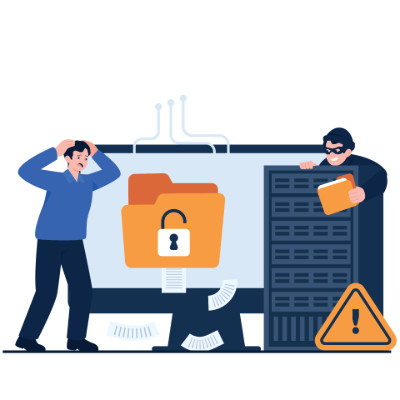
If you still treat IT as a secondary expense, you are probably overlooking the biggest threat to your profit. Your digital infrastructure is the plumbing of your revenue. It is either a vault protecting what you earn or a sieve quietly draining your margins. The real point is simple: cybersecurity is not a tech problem stuck in a back office, it is a direct pillar of your financial stability.
Look at it like a thief would
Standard IT companies promise safety, but that is abstract when you are trying to make payroll on Friday. A more useful lens is to ask where your money is actually exposed and what a specific weakness would cost you. Look at your business the way a thief does and one thing becomes clear: lazy habits are usually more dangerous than master hackers. The question is not just how good the lock is, it is how fast you can recover after the door gets kicked in.
The habits that stop the bleeding
Security is less about buying the right software and more about disciplined behavior. Start with a second-channel rule. No wire transfer or change to banking details, especially anything sizable, gets approved on email alone. A quick call to a known number to confirm the request stops most fraud cold. Move your team from passwords to passphrases, which are easier to remember and harder to crack. And treat a stray USB drive found in the parking lot, or an unlocked server closet, as the threat it is.
How the con actually works
Attackers rarely blast their way in. They exploit what you could call the nice-guy tax, weaponizing your employees natural urge to be helpful. The cycle is predictable. They research your company on social media, then send a message that mimics the boss tone and manufactures urgency, then ask for a small favor like checking an invoice. Once someone clicks, they vanish with the money before anyone notices. That is why small businesses are often better targets than banks, no billion-dollar defenses, plenty of helpful staff who do not want to tell the boss no.
What is actually at stake
Ignore these leaks and you risk the foundation of the company. Beyond the immediate loss, there is reputational damage and the very real possibility of sitting idle for weeks while systems are painstakingly restored.
Do not wait for a financial gut-punch to notice the bucket is leaking. Book a call and we will translate your security from jargon into real-world protection.

The Trojan Horse did not work because the Greeks broke down the walls. It worked because the Trojans wheeled a threat inside the walls themselves, thinking it was a gift. Your business faces a version of the same risk, except today the package is a tool or platform you bought from a third-party vendor. Third-party risk is a weakness that starts at a company you work with, like handing a spare key to a house-sitter who then loses it. These risks are behind a lot of data breaches, so they are worth taking seriously.
What a vendor risk assessment checks
The fix is a third-party risk assessment, basically a background check on whether a vendor takes security as seriously as you do. Focus on three things. Data handling, how your data is stored and protected while it sits with them. Access control, how few of their people can actually see what you have entrusted to them. And redundancy, how badly an outage on their end would hurt you.
Why it lands on you
Say you use a vendor for payment processing and they lose your customers credit card details. Who do your customers and the regulators point at first? You. Outsourcing can be great, but a breach on their side still leaves you holding a very expensive bill and the reputational damage. Their security posture is, functionally, part of yours.
How to keep vendors accountable
Once you have vendors you trust, keeping them honest is not a huge lift. Remember that different vendors hold different data, so they carry different risk. A janitorial service might only have your billing info, while a CRM or outsourced HR provider holds your client and employee data too. Hold the higher-risk ones to a higher bar. And ask for proof. Any vendor worth working with should have no trouble confirming their security practices, and if one balks, that alone tells you it is time to go back to the negotiating table.
We help make sure your vendor relationships stay an asset, vetting providers, facilitating the relationship, and keeping an eye on them so their protections do not quietly slip. Book a call and we will help you watch the watchmen.

Good-enough compliance is over. Regulators now use the same advanced AI as the private sector to scan records and flag inconsistencies in seconds. Relying on manual spreadsheets is no longer just slow, it is a liability. Compliance has gone from a back-office chore to part of the core infrastructure that keeps a business legal and running. Here is how the landscape is shifting and what to do about it.
From fixing problems to preventing them
Compliance used to mean looking backward to clean up last quarter mistakes. AI-driven automation has flipped that into real-time defense. Continuous monitoring tools watch logs and transactions around the clock and flag anomalies the moment they appear, and predictive analytics use past patterns to point at where a slip-up or breach is most likely before it happens.
The new AI rules
In an ironic twist, the technology used to ensure compliance is now itself regulated, and the rules are a moving target. Two big ones are shaping things. The EU AI Act is real and phasing in, with its major obligations for high-risk systems landing on August 2, 2026. California Transparency in Frontier Artificial Intelligence Act took effect January 1, 2026, the first state law of its kind. Both aim mainly at the companies building frontier AI models, not the average small business, but they set the direction every regulator is heading, and the expectations trickle down through cyber insurance and contracts. Modern governance, risk, and compliance platforms help by syncing your internal policies with new laws automatically and keeping immutable records of where data came from and how a decision was made.
One source of truth
Most non-compliance traces back to data silos, where the left hand does not know what the right is doing. Centralizing your data, often on a cloud ERP, makes every decision logged and traceable, from sourcing to customer privacy. It also lets you honor data residency and sovereignty rules, because you can actually see where information lives and who touched it.
Automate the response
When a threat does surface, speed matters, since breach-notification laws come with tight windows. The right setup isolates the problem instantly and can generate the required regulatory reports automatically, so you meet the deadline instead of scrambling. Staying compliant in 2026 is less about working harder and more about putting the right technology to work.
Book a call and we will help you modernize your compliance setup before the rules catch you out.

© 2026 CybertronIT. All rights reserved.Privacy Policy · Sitemap